
Strategic Career Placement Engineering
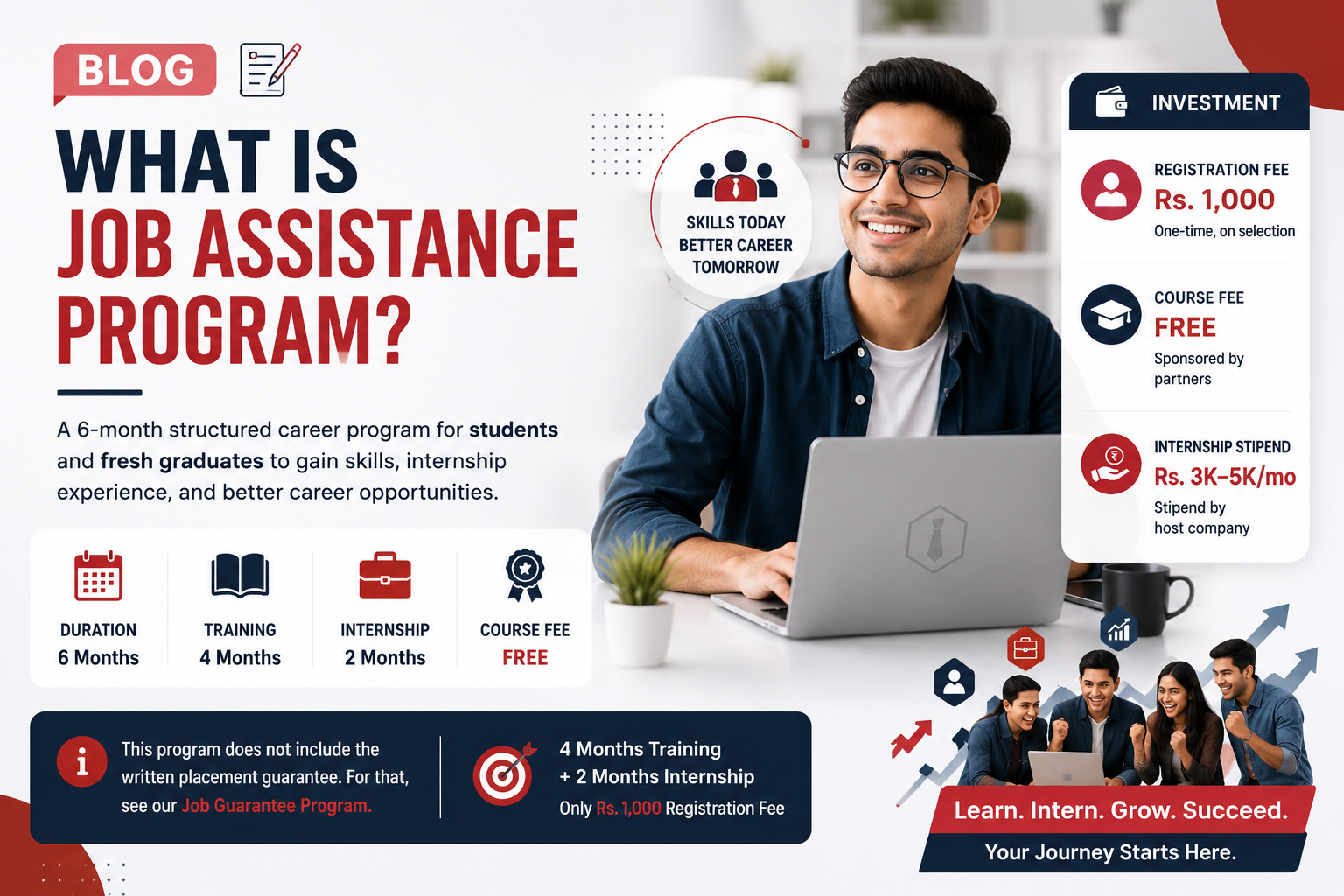
Understanding exactly what is job assistance can completely alter a student's professional trajectory. Many academic applicants invest blindly in a standard best it training program or search for a free training program, only to realize they lack corporate placement support. The specialized job assistance program by Job Guarantee Program bridges this exact gap, combining a rigorous skill accelerator program with personalized industry mentoring.
Deconstructing the Pillars of Real-World Placement Support
Navigating the employment market without a clear strategy often results in endless applications with zero responses. A dedicated job placement program changes the game by focusing intensely on your complete job readiness. From step-by-step resume building to live, technical interview preparation, every element of our program ensures your profile passes corporate screening filters. This practical alignment helps candidates secure an early internship training program path that leads to long-term career assistance.
Active discussions on the popular Reddit Jobs Community and tracking metrics on the Quora Skills Dashboard show that generic resumes are immediately ignored. Corporate recruiting portals like Naukari require candidates to present concrete proof of their tech skills. Enrolling in a focused career assistance system that forces you to build live code environments ensures your resume gets noticed by corporate recruiters.
This clear shift toward active, placement-backed learning models is thoroughly documented by independent global hiring reports. Key analytics published in the Global Job Skills Market Research document confirm that practical project verification, mock interview practice, and direct portal alignment are the leading factors in rapid technical placements.
How the Job Guarantee Program Translates Training into Employment
Determining how to find free training program in 2026 that includes top-tier placement channels is a massive priority for young tech applicants. The Job Guarantee Program answers this challenge by running high-value, practical development tracks that act as a direct career accelerator. Whether you pick an advanced graphic design course, an intensive full stack course, or a fast-paced coding bootcamp online, our framework turns academic theory into real corporate skills.
The complete operational roadmap is carefully broken into three practical placement layers to build genuine confidence without creating educational fatigue:
Layer 1: Hands-On Projects & Portfolio Construction
Students complete challenging, multi-layer hands on projects that mimic actual corporate assignments. This approach bypasses old textbook methods by forcing learners to deploy live code and design assets directly onto public web channels. It serves as an elite, practical foundation for any modern student tech program participant.
Layer 2: Corporate Interview Preparation & Resume Building
This layer shapes raw technical skills into a highly polished corporate format. Our career advisors walk you through systematic profile adjustments, portfolio presentation reviews, and live mock interview practice. This rigorous preparation guarantees that your application stands out during competitive corporate hiring rounds.
Layer 3: Direct Integration with Recruitment Channels
Graduates gain an immediate advantage by connecting directly with active job directories. Your verified profile, live project links, and completion badges are funneled straight into specialized recruitment channels. This automated connection helps students land an entry-level technical role or secure a highly competitive paid internship training program track.
| Operational Features | Standard Training Courses | JTP Job Assistance Program | Direct Student Career Advantages |
|---|---|---|---|
| Placement Support | Generic email list shares with no real corporate tracking | Direct, continuous live online mentorship and company tracking | Connects your profile directly with corporate recruiters looking for fresh talent |
| Interview Readiness | Basic text documents with zero live verbal practice | Live mock interviews with detailed professional critiques | Removes interview anxiety by training you to answer complex technical questions easily |
| Career Integration | Automated certificate delivery with zero portal mapping | Direct profiling inside the specialized Kramate Job Portal | Bypasses generic application pools by putting your work straight in front of hiring managers |
Balancing University Education with Evening Technical Labs
The main reason our framework ranks as a top-tier career growth course for college students is our highly organized calendar layout. Running entirely through structured weekend and evening batches, the program helps you maintain a perfect work life study balance. Students can master complex software codebases or focus on intensive creative layouts from home without missing a single daytime university lecture. This balanced setup delivers a practical, highly convenient best evening course environment.
This focus on flexible, premium training is why our setup stands out as a highly effective system for skill training for students. By ensuring this deep affordable tech course remains highly accessible, we give young learners everywhere the tools to build real corporate value. The interactive setup ensures every student builds tangible skill proof.
Our localized expansion tracks fit national professional skilling policies perfectly. Regional pathways like the specialized ayodhya design course, ayodhya certification, and ayodhya evening training tracks follow the official guidelines set by the National Skilling and Employability Framework Initiatives. This standardizes instructional quality, giving all students equal access to competitive tech training.
Adhering to Open Industry Layout and Optimization Benchmarks
To ensure all student project work ranks well on global web channels, our development modules integrate standard optimization blueprints. Every web creation lab follows the guidelines outlined in the official Search Engine Optimization (SEO) Starter Document. Students learn exactly how web crawlers analyze data maps, parse header hierarchies, and index layout scripts.
Similarly, our programming sandboxes align completely with the clean formatting rules and conventions established by the Official Programming Language Ecosystem and Documentation. Mastering this code quality early prevents common system bugs and prepares students to build clean, professional-grade software setups.
The long-term career benefits of early, hands-on skills are heavily documented in recent national studies. Market indicators inside the official National Artificial Intelligence Adoption Indicators report show an expanding corporate demand for young talent who understand active scripting logic, web search optimization, and responsive design systems.
| Syllabus Track | Interactive Tools Used | Tangible Student Project Output | True Market Employment Value |
|---|---|---|---|
| Profile Optimization | ATS Simulation Matchers, Grid Formatters | An immaculate, automated-screening-ready tech resume | Ensures your application survives corporate screening filters easily |
| Interview Training | Live Audio Panels, Video Review Buffers | Recorded and polished mock technical interview sessions | Builds the verbal confidence needed to pass high-pressure corporate reviews |
| Portfolio Integration | Public Server Deployers, Link Managers | A live, clickable web catalog hosting your technical work | Gives hiring managers instant, verifiable proof of your real-world tech skills |
An affordable tech course only delivers true value when it provides a clear pathway into the corporate workspace. Many learning systems abandon students immediately after graduation, leaving them with no guidance on how to secure actual technical interviews. The Junior Training Program solves this problem completely by connecting student dashboards directly with the active Kramate employment ecosystem, giving you a distinct advantage in the job market.
By uploading your projects to live public networks and working closely with the Job Assistant Program team, your classroom efforts convert directly into corporate interview invitations. Students showcase their clickable portfolio links to hiring scouts inside the specialized Kramate panel, creating a reliable path toward a secure Kramate Internship. This active career support helps our graduates stand out from thousands of uncertified applicants.
To ensure all student design layouts meet high aesthetic benchmarks, our training modules use the Industry-Standard Creative Portfolio Guidelines. This specialized training helps students master correct padding balance, spatial harmony, and responsive grid layouts used by top design firms worldwide.
Course Completion Notice: Completing all live mock interviews and finishing your public portfolio layout is strictly required to graduate. This rule ensures every student is fully prepared to pass competitive company interviews.
Long-Term Employment Benefits of Validated Skill Prep
The clear career advantage of early, interactive skill training is heavily backed by global employment indicators. Independent data inside the comprehensive Digital Literacy Benchmark Statistics document confirm that candidates who practice with active development platforms early show vastly superior project completion metrics than peers who study flat theory alone.
At the same time, macro-employment analytics point to a massive, long-term global corporate demand for these core tech skills. According to tracking metrics published in the Annual Tech Skills and Workforce Trajectory Analysis, professional fluency in user layouts, database connectivity patterns, and web optimization rules remains a massive priority for corporate recruiting boards globally.
To help speed up asset construction during training, students learn to apply pre-tested layout matrices from the Open-Source Design Asset Hub. Working with these open-source grids saves hours of styling code and teaches you exactly how professional web platforms scale fluidly across various viewports.
Student Placement Milestones
1. System Optimization
Secure your batch slot online to open your student panel, configuring your tech applications and scheduling your preparation blocks cleanly.
2. Live Mock Preparations
Join intensive mock interview sessions with real-world tech professionals, refining your answers and fixing technical mistakes in real time.
3. Portfolio Deployment
Build and launch original project platforms during regular milestone checks, hosting your verified code on live public channels.
4. Active Portal Integration
Earn your professional graduation credentials after completing all modules, connecting your portfolio links directly to active corporate recruitment channels.
Frequently Asked Questions (Job Assistance Guide)
Q1: What exactly does the job assistance program provide to fresh graduates?
Our program delivers complete end-to-end placement support. This includes professional resume building, technical mock interview prep, live profile optimization, and direct mapping into the Kramate corporate directory.
Q2: How do the evening and weekend batches benefit working students?
All our interactive labs run during off-peak evening hours and weekends. This smart scheduling helps you maintain an absolute work-life-study balance, letting you attend college during the day and build skills at night.
Q3: Is the training program completely beginner-friendly?
Yes, our complete training pipeline is designed for absolute beginners. We guide you step-by-step from core tech concepts all the way to advanced corporate project deployment.
Q4: How do mock interviews prepare students for actual company reviews?
Our mock interview sessions mimic actual corporate hiring environments. Real-world industry professionals test your skills, score your answers, and provide detailed feedback to help you improve.
Q5: How does my completed portfolio connect with the Kramate Job Portal?
Once you finish your training modules and deploy your public project links, our system uploads your verified profile straight into the Kramate system, making your skills visible to corporate partners.
Q6: Does this placement support model align with national skill framework rules?
Yes, our complete career roadmap is carefully structured to line up with national employability initiatives, ensuring your credentials hold high value in the professional job market.
Q7: What happens if I make a technical mistake on my portfolio deployment code?
You can bring any codebase blocker directly to our live online mentorship sessions. Our tech instructors will review your code configuration and show you exactly how to fix the error.
Q8: Are regional options like the ayodhya evening training identical in quality?
Yes, all our regional training options connect to the exact same high-tier syllabus, live cloud terminals, corporate mentor access, and unified career placement pipelines across the country.